
The History of Playing Cards
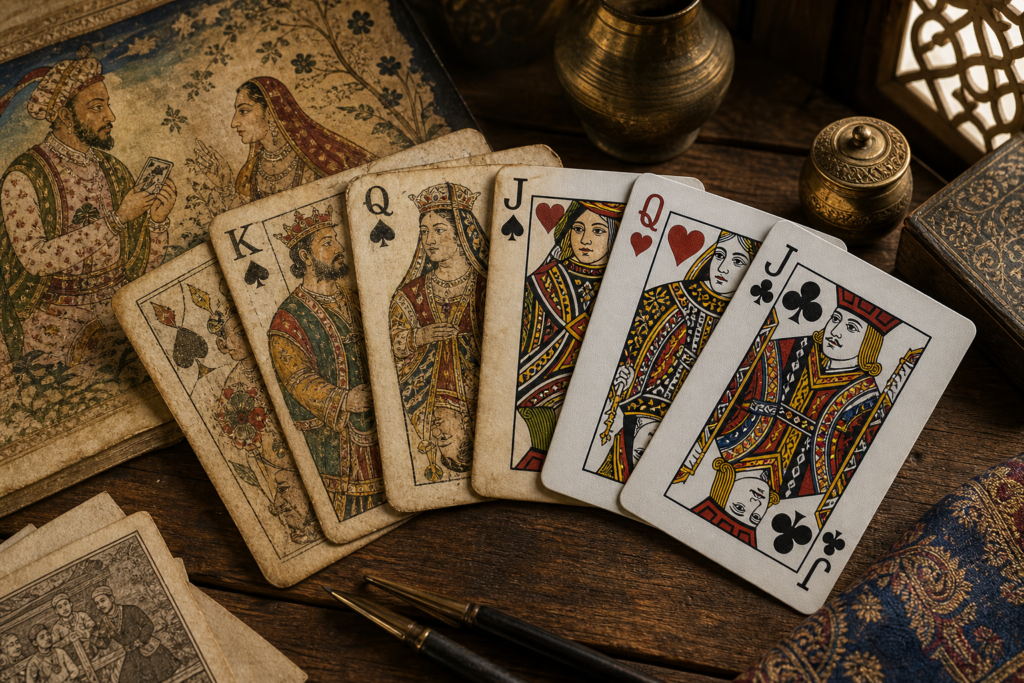
Playing cards are so ordinary that we forget how strange they are: fifty-two numbered and ranked pieces of pasteboard, divided into four suits, shuffled and dealt the same way in Tokyo, Toronto, and Tripoli. That uniformity did not happen overnight. The deck in your drawer is the end product of a thousand-year journey—from hand-painted court cards in medieval workshops to precision-cut stock rolling off modern presses.
The earliest ancestors: China and the Silk Road
Most historians trace playing cards to 9th-century China, during the Tang dynasty. Early references describe “leaf games”—printed or painted slips used for gambling and entertainment. These were not quite modern cards; some used domino-like tiles or paper sheets with suits tied to currency denominations. Still, the core idea was there: standardized symbols, ranked values, and games built around drawing and comparing them.
From China, card-like games spread along trade routes into Persia and the Arab world. By the 14th century, the Mamluk Sultanate in Egypt was producing elaborate hand-painted decks with suits of cups, coins, swords, and polo sticks—designs that still echo in today’s tarot and Spanish-suited packs. Polo sticks later became batons or clubs as the game moved westward.
Arrival in Europe: Italy, Spain, and the courtly deck
Playing cards reached southern Europe in the late 1300s, probably through Mediterranean trade and Moorish Spain. Italian and Spanish decks kept the Mamluk structure: swords, cups, coins, and batons—with elaborate hand-painted kings, knights, and knaves. These packs were luxury goods, commissioned by nobles and painted by workshop artists. Owning a fine deck was a status symbol, much like illuminated manuscripts.
- Italian tarocchi — added a permanent fifth suit of twenty-two trump cards, ancestor of modern tarot
- Spanish baraja — forty-card packs (no 8s or 9s) still used for games like mus and brisca
- German-suited decks — hearts, bells, acorns, and leaves; common across Central Europe into the 1800s
As cards spread north, local suit systems multiplied. A traveller in 1500 might encounter four or five different deck styles within a few hundred miles—each with its own court-card names and regional games.
The French revolution in design

The deck most of the world uses today—hearts, diamonds, clubs, and spades—crystallized in France around the 1480s and spread globally through colonization, trade, and the rise of French playing-card manufacturers in the 18th and 19th centuries. French artisans simplified and standardized the court cards: kings, queens, and jacks (valet) with recognizable, repeatable designs that could be stamped and printed rather than painted one by one.
Two details from this era still shape every poker night:
- Double-ended court cards — printed so either orientation reads upright, reducing wear from flipping
- Corner indices — rank and suit in the corners, patented in the 1870s, letting players fan a hand without exposing the whole card
English card makers adopted the French suit system in the 17th century and added their own twist: the ace of spades carried elaborate tax stamps (a revenue mark proving duty had been paid). That tradition of a decorated ace of spades survives in many decks today.
Industrial printing and the modern 52-card pack

The 19th century transformed cards from craft to industry. Lithography, then offset printing, made decks affordable for everyone. Card makers in Belgium, Germany, and the United States competed on quality: cardstock weight, varnish, precise caliper (thickness), and clean cuts. The 52-card French-suited pack plus two jokers became the international default—not because it was the only option, but because it traveled well with sailors, soldiers, and emigrants.
- Linoleum and plastic coatings — improved shuffle feel and durability from the mid-20th century onward
- Casino-grade standards — narrow tolerances on size (poker size ≈ 63 × 88 mm) so dealers and machines handle any manufacturer’s deck
- Collectors and custom decks — art, magic, and cardistry communities pushed design far beyond the Bicycle standard
Today’s premium decks—like those made for serious players and collectors—inherit that long refinement: linen finishes for smooth shuffling, crisp registration on face cards, and stock stiff enough to spring but flexible enough to faro. A deck such as 575 Playing Cards sits in that lineage: modern manufacturing applied to a format that has not fundamentally changed since the French workshops of five centuries ago.
Why the same deck works everywhere
Standardization is playing cards’ secret weapon. Learn Gin Rummy in London and you can teach it in Lagos with the same pack. The French suits crossed borders because they were simple to print, easy to read, and detached from any one nation’s heraldry. Jokers—American additions from the 1860s euchre craze—slotted in as wild cards without breaking older games.
Regional decks never vanished entirely. Tarot packs still serve fortunetelling and games like French tarot and Königrufen. Germany’s skat players use a 32-card French-suited subset. Italy’s scopa uses a 40-card stripped deck. But when someone says “a deck of cards” without qualification, they mean the 52-card French pack—and that shared assumption is itself a piece of cultural history.
A small object with a long memory
Every shuffle connects you to centuries of players: Tang dynasty gamblers, Mamluk courtiers, Parisian print shops, Mississippi riverboat sharps, and the family at your kitchen table last weekend. Playing cards are among the world’s most successful pieces of design—portable, legible, and endlessly recombinable. Whether you are dealing Lebanese Rummy, teaching a grandchild Go Fish, or hosting a poker night, you are using a technology that has been refined for a very long time.
Next time you break the seal on a fresh deck, take a second look at the court cards and the ace of spades. They are not just decoration—they are the compressed history of a game that never stopped traveling.