
Head-Turning Ways to Shuffle During Your Next Game
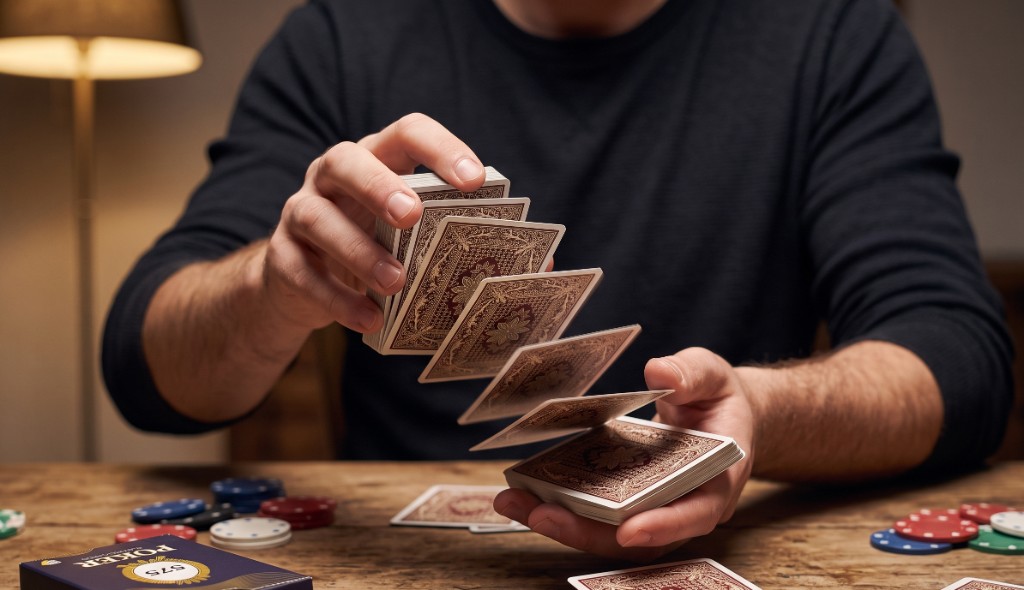
A good shuffle does two jobs: it mixes the deck, and it looks like you meant to do it. You do not need a false cut or a move that keeps cards in place. The mixes below are fair, they read well from across the table, and they suit the games people actually play with a poker deck—rummy, teen patti, poker, and bridge. Finish with a real mix before anyone is dealt cards.
How many times is enough?
Mathematicians Persi Diaconis and Dave Bayer showed that about seven riffle shuffles bring a 52-card deck close to random. Three casual riffles still leave clumps of the old order, which is why a “quick shuffle” before rummy sometimes deals someone a run they did not earn. If you mix another way, give the deck several full passes, not one. Offer the pack for a cut when the table expects it.
1. The table riffle and bridge
This is the shuffle people picture. Split the deck into two roughly equal halves. Hold each half from the short edges, thumbs on the near side, and let the corners flick off your thumbs so the two packets interleave. Square the deck. Then bend it gently and let the cards cascade down in a bridge—the waterfall that snaps the pack back into one block.
That cascade is the head-turning part, and it does not replace the riffle. Do the riffle several times, then the bridge once at the end so the deck looks tidy for the deal. Keep the bend modest. A hard bridge creases paper and can leave a lasting bend in plastic cards.
2. The Hindu shuffle
The Hindu shuffle is the usual mix at Indian rummy and teen patti tables, and it works in a smaller space than a riffle. Hold the deck in one hand, fingers along one long edge and thumb on the other. With the other hand, take a packet off the top from the long edges and drop it into the free palm. Repeat, dropping each new packet onto the growing pile, until the deck has changed hands. Do it three or four times.
Vary the size of the packets. If you always pull the same thin slice, the deck mostly stays in blocks. A few thicker grabs, then a few thinner ones, breaks those blocks up. It also looks practised once the rhythm is even—no spray of cards, no bent corners.
3. The overhand shuffle
Hold the deck in one hand. With the other, lift most of the pack and drop small packets from the back of that lifted block onto a new pile. The classic “clump, clump, clump” is an overhand shuffle. It is slower to randomise than a riffle, so give it more passes—on the order of a dozen short runs—before a serious game.
Use it when the table is crowded or when you are teaching someone who is not ready to riffle. The motion stays over the deck, which matters on a sofa or a train tray. For games that fit that kind of space, see card games for a plane ride.
4. The wash
Spread the cards face down in a loose mess and swirl them with both hands for several seconds, then square the deck. Casinos call this a wash or a scramble. It looks informal and it mixes very well, including face-up clumps a riffle might leave if you only do it once.
You need a clean table bigger than the deck. It is a strong choice for nylon plastic cards, which do not love a deep bend. Paper decks wash well too, as long as the table is dry. If the surface is gritty, skip it—the faces will pick up marks that become tells. Storage and when to retire a marked pack are covered in how to care for playing cards.
5. A display interleave is not a shuffle
A perfect faro drops one card from each half in exact alternation. It looks precise. It is a poor mix: done cleanly, it is a rearrangement you could undo, not a random order. Treat it as a flourish between games if the table enjoys it, then follow with a riffle, a Hindu shuffle, or a wash before the next deal. Never deal off a single perfect interleave and call the deck shuffled.
Match the shuffle to the cards
- Paper and German board — table riffle plus a light bridge. The stock is built for that flex. See why the board matters.
- Nylon plastic — Hindu shuffle, overhand, wash, or a gentle riffle. Skip a sharp bridge so the cards stay flat.
- Any deck — square the cards, offer a cut, and deal from a packed deck so the bottom card stays hidden.
If your weekly game wears the corners off a pack, rotate in a new deck before the backs get shiny. A prepaid subscription is the simple way to keep that spare on the shelf. Until then, seven honest riffles—or a wash and a Hindu shuffle—will do more for the game than any trick that leaves the cards where they were.