
Building a House of Cards with a Standard Deck: Balance, Bends, and a Steady Table
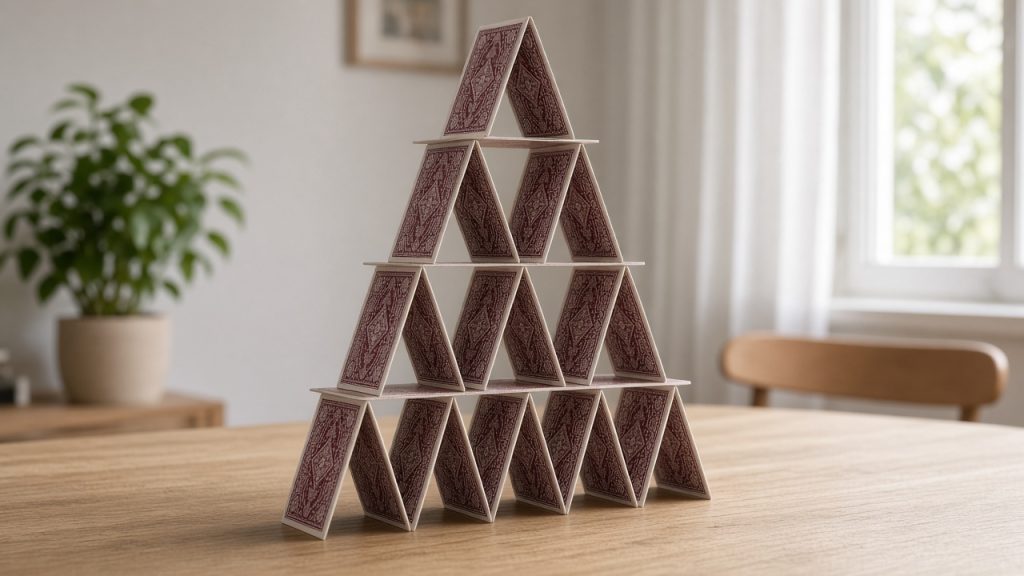
Building a house of cards is the quiet opposite of a loud card night. No chips, no scores—just friction, balance, and the small satisfaction when a third storey holds. You only need one standard 52-card deck, a flat surface, and a few minutes of still air. This guide walks through a simple triangle stack most people can finish on the first try, how to rescue a wobble without knocking everything down, and which deck traits help (stiff paper, square corners, a back that is not peeling). When the tower falls, you still have a full pack for two-player and solo games or a proper shuffle before the real dealing starts.
What you need
- One deck of 52 playing cards. Jokers stay in the box unless you want spare “roof” cards.
- A rigid table—dining wood, laminate, or a large hardcover book on your lap will not cut it.
- Dry hands and no fan pointed at the table. HVAC gusts are the number-one house killer.
- Room to lean back when you place the top cards. Elbows on the table transfer vibration straight into the base.
How the cards stand up
Each “wall” is two cards leaning together in an A-frame, touching along their long edges and meeting at a point on the table. Gravity pulls the tops together; the table pushes the bottoms apart. That triangle is stable only if both cards bend equally and the table is level. You are not stacking face-up poker hands—you are using the card as a thin beam. Decks with a little flex (quality paper board) forgive small errors better than glass-stiff plastic, though plastic can work if you build lower and slower. Compare materials in plastic vs paper.
Build it step by step
1. The base row
Place two cards as one triangle near the centre of the table. Add a second triangle beside it so the right card of the first pair nearly touches the left card of the second. Repeat until you have a line of four or five triangles—about eight to ten cards total. Gaps wider than a few millimetres wobble; pairs that overlap will fight each other. Tap the table once with one finger: if the row shivers, rebuild on a steadier spot.
2. The first roof
Lay one card flat across the tops of two neighbouring triangles, like a bridge. It should rest on both peaks at once. Add another roof card beside it until the whole base row is capped. These horizontal cards lock the A-frames in place. Breathe out before each roof—rushing here is how beginners launch cards across the room.
3. Second storey and above
On top of the roof, build a new row of triangles—one fewer pair than the floor below so the pyramid steps in. Cap with another roof. A satisfying home build is three floors high (base + two step-backs) and uses roughly half the deck. Save the last cards for a single triangle “chimney” on top if you are feeling brave.
4. When it leans
Do not slap the table to “fix” a lean. Freeze. Identify which triangle opened at the bottom—usually one card slid. Gently nudge that card’s bottom edge back toward centre with one fingertip. If the roof is the problem, lift it off with two fingers, square the triangles below, and replace the roof. Walking away for ten seconds also works; micro-vibrations from frustrated tapping often do the real damage.
Beginner mistakes
- Building on a tablecloth. Fabric lets cards creep. Use bare wood or a placemat with zero pile.
- Using a warped deck. Cards that already bow will not make symmetric A-frames. Retire bent packs to stack-only duty; see how to care for playing cards.
- Chasing height too fast. A two-storey house that stands for a minute beats a four-storey collapse. Add floors only when the last roof has been still for a slow count of five.
- Building with the game deck mid-tournament. Grease from snacks and curled corners from riffle shuffles make stacking harder. Keep a spare 575 Poker deck or 575 Premium bridge deck for crafts while the main pack stays in play.
Make it a challenge
Once a three-storey house is boring, try rules: only one hand may touch the deck, no speaking during roof placement, or rebuild after every collapse without reshuffling the fallen cards into order. For a party, pair stacking with easy card tricks—the same deck, two different skills. Kids under eight often prefer knocking it down to building it; let them “demolition crew” after you photograph the tower.
Decks that stack well
Look for crisp corners, consistent thickness, and a smooth finish that is not sticky. Paper 575 Poker cards have enough flex for classic A-frames; Nylon Poker plastic suits humid rooms and sticky fingers but rewards a lower, wider base. If you burn through practice decks while learning, a prepaid subscription keeps a fresh pack on the shelf without another checkout. And when the house finally stands, take the photo before anyone breathes on it—then deal a real hand and let gravity win the next round.