
Card Games for Family Game Night: Beyond Rummy and Poker
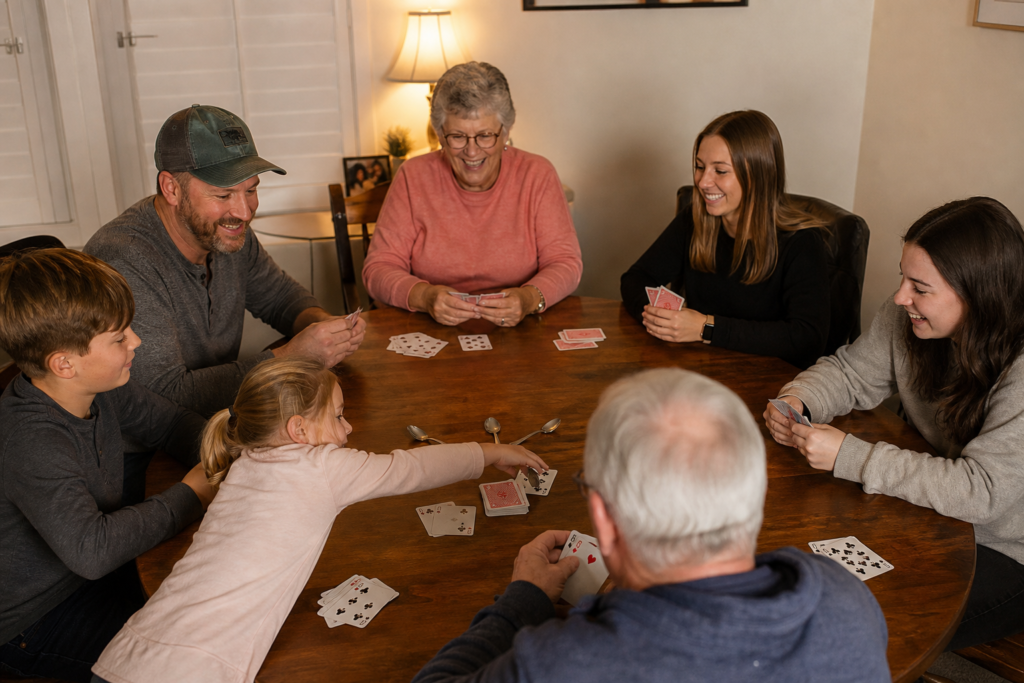
Most households that own playing cards eventually settle into one or two favourites—often rummy at the kitchen table and maybe poker when adults stay up late. That is a fine tradition, but a single standard deck can power a whole evening of faster, sillier games that suit mixed ages and short attention spans. The four below need no special equipment beyond a 52-card pack, a flat surface, and the willingness to laugh when someone slaps the pile too early.
Why branch out beyond rummy and poker?
- Shorter rounds — a full hand of rummy can run twenty minutes; Speed or Spoons often finishes in under five
- Mixed skill levels — grandparents, teens, and younger children can all compete without memorising meld rules
- Energy control — loud games (Spoons) and quiet ones (Cheat) let you match the room
- Math without worksheets — counting pairs and comparing ranks sneaks in the same skills as our arithmetic with cards guide
- Quality time — the same low-screen ritual that makes card time with grandkids special works for whole-family nights
Rotate one “new” game between familiar rummy deals so nobody feels lost. Keep a dedicated family deck—575 Playing Cards in poker size shuffles cleanly and survives enthusiastic slaps.
Speed (Spit): reflexes and focus
Players: 2 (a three-player variant exists but two is classic). Time: 5–15 minutes per round.
Each player gets half the deck face-down as a stock pile, then lays four cards face-up in a row in front of them. Two centre piles start empty. On “go,” both players flip one stock card face-up onto a centre pile and race to play cards from their row onto either pile—one rank higher or one rank lower (suits ignored; aces wrap high–low). When stuck, both flip a new stock card onto the piles. First to clear their row and stock wins.
- Family twist: play best of three; let younger players use both centre piles while adults use one
- Quiet rule: no talking during play—surprisingly hard and funny
- Watch for: bent corners from frantic slapping; rotate in a fresh deck if cards mark
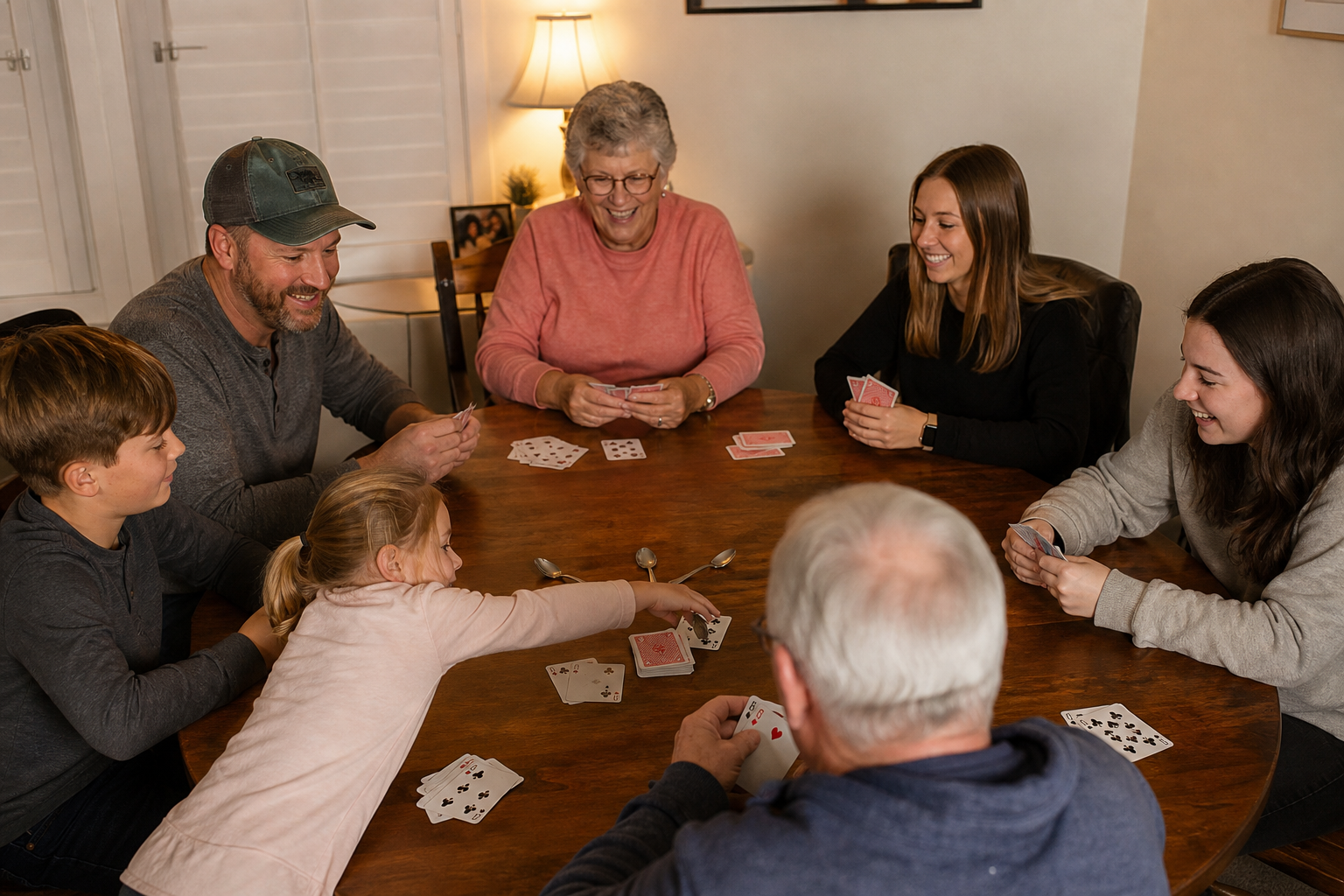
Spoons: chaos with a safety valve
Players: 4–8 (one fewer spoon than players, placed in the centre). Time: 10–20 minutes.
Deal four cards each. The dealer draws one card from the deck, keeps one, and passes one left. Everyone passes simultaneously. When someone collects four of a kind, they grab a spoon—quietly or with a yell, house style. Others scramble for the remaining spoons; one player is spoonless each round and earns a letter toward “S-P-O-O-N-S.” Last player standing wins.
- No spoons? Use pens, coasters, or folded napkins—anything grab-able
- Younger children: play with three-card hands and three of a kind
- After dinner: move breakables; this game gets physical
Cheat (I Doubt It): bluffing and reading the table
Players: 3–6. Time: 15–25 minutes.
Deal the pack evenly. Play proceeds by rank: the first player must lay one or more aces face-down in the centre and announce “one ace” (or “two aces,” etc.). The next player lays twos, then threes, and so on. You may bluff—play a different rank while claiming the correct one. Before the next player acts, anyone may call “Cheat!” If the pile is inspected and the claim was false, the liar picks up the whole centre pile. If the claim was true, the challenger picks it up. First to empty their hand wins.
- Family tone: ban mean-spirited accusations; celebrate audacious bluffs
- Teens love it — social deduction without a phone
- Pair with a calm game afterward so younger children are not only bluffed at
Uno-style with a standard deck
You do not need a proprietary Uno pack. A standard 52-card deck plus jokers (optional) gives you a similar shedding game with house rules everyone agrees on before the first card.
Simple “match and shed” rules
- Deal seven cards each; flip one face-up to start the discard pile
- On your turn play a card that matches the top card by suit or rank, or draw one card
- Eights are wild — name a new suit when you play one
- Face cards (optional power-ups): Jack = skip next player; Queen = reverse direction; King = force next player to draw two
- First to empty their hand wins the round; play to a point total or best of five rounds
Write the power-ups on a sticky note the first time you play—children enjoy inventing variants (“twos make everyone draw one”). The goal is flow, not tournament law.
Building a family game-night rotation
A practical ninety-minute structure keeps energy high without exhausting the youngest player:
- 0:00–0:15 — Speed (warm-up, standing optional)
- 0:15–0:35 — Uno-style shedding game (seated, conversational)
- 0:35–0:55 — Spoons (movement break)
- 0:55–1:15 — Cheat (older children and adults)
- 1:15–1:30 — one rummy hand for the purists, then dessert
Let children choose the order next week—ownership keeps them at the table. For arithmetic practice disguised as play, borrow ideas from learning basic arithmetic with cards between rounds.
What to have on hand
- Two identical poker-size decks — one in play, one backup when corners bend
- Spoons or tokens — one fewer than players for Spoons
- Snacks that are not greasy — sticky fingers mark cards; see plastic vs paper if spills are common
- A written house rule card — especially for Uno-style power-ups, so arguments stay short
When to return to rummy or poker
These quick games are appetizers, not replacements. When the table wants deeper strategy, shift to 13-card vs 21-card rummy, gin for two, or a proper poker hand-rankings refresher before stakes go on the table. The best family night uses one deck to meet everyone where they are—then deals another hand because nobody wants to stop.
Stock fresh decks from the 575 shop, browse rummy cards and poker cards for your main games, and keep the quick-hit rotation ready for the next Friday at the table.