
13-Card vs 21-Card Rummy: Key Differences Explained
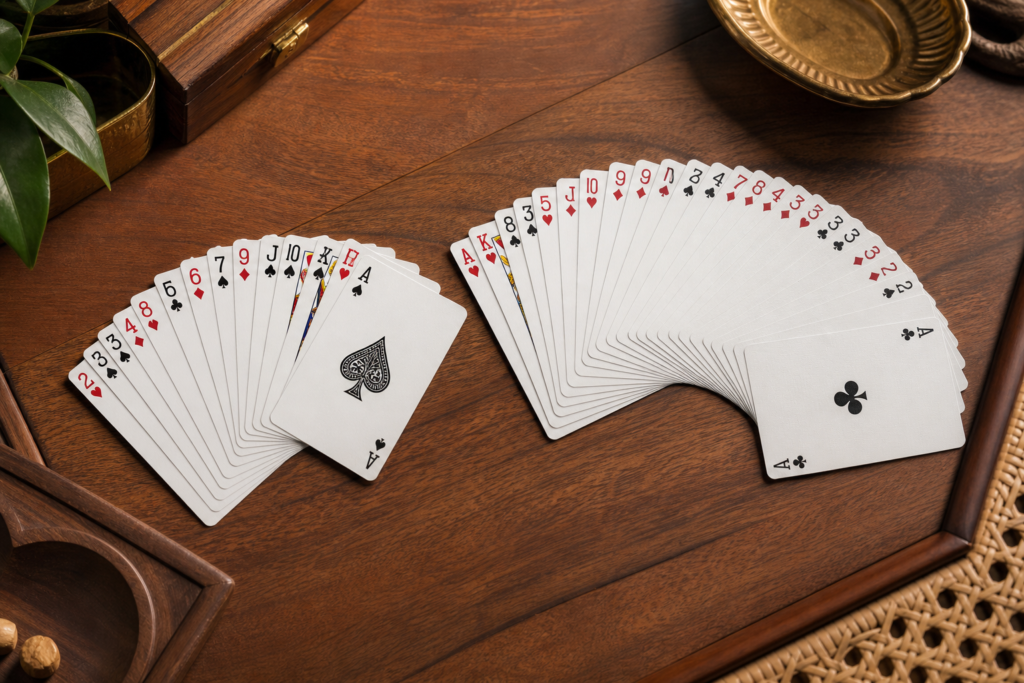
Ask an Indian card table which rummy they play and you will usually hear one of two answers: 13-card or 21-card. Both are draw-and-discard games built on sequences and sets. The difference is scale—how many cards you hold, how many decks you shuffle, and how much patience the declare demands. Here is a clear side-by-side so you can pick the right night for your group.
Quick comparison
- Hand size: 13 cards vs 21 cards
- Decks: one or two packs (13-card) vs typically three packs (21-card)
- Players: 2–6 for 13-card; often 2–4 for 21-card (more cards leave less stock)
- Pace: 13-card deals finish faster; 21-card sessions run longer and deeper
- Declare bar: one pure sequence is the classic 13-card gate; 21-card usually wants more sequences (often including extra pure ones)—confirm house rules before you deal
13-card rummy: the everyday standard
Indian 13-card rummy is what most family nights, club apps, and points/pool formats mean by “rummy.” You are dealt thirteen cards from one deck (two decks once three or more players sit down). Printed jokers plus a turned wild rank help fill gaps. The non-negotiable rule at most tables: arrange the whole hand into valid melds with at least one pure sequence (a same-suit run with no joker) before you declare.
- Best for: mixed skill levels, short rounds, online-style points or pool scoring
- Feel: sharp decisions, discard reading, and a clean race to declare
- Deck need: a matching twin pack once the table grows past two players
21-card rummy: bigger hand, bigger puzzle
21-card rummy keeps the same meld language—sequences and sets—but deals twenty-one cards per player, almost always from three shuffled decks (plus jokers). More cards mean more ways to build long runs and multi-set layouts, and also more deadwood risk if you mis-time a declare. Tables commonly require several sequences (often with more than one pure sequence) before a hand is legal; exact counts vary by club and house, so agree the checklist out loud.
- Best for: experienced players who enjoy longer deals and denser sorting
- Feel: slower tempo, heavier fanning, more planning across the whole hand
- Deck need: three identical packs so the combined shoe shuffles as one
Melds and declare: same ideas, different bar
In both variants a sequence is consecutive cards of one suit and a set is three or four of a kind in different suits. Jokers (printed and wild-rank) fill holes in impure sequences and sets. Where they diverge is the finish line:
- 13-card: typically all thirteen cards melded, including at least one pure sequence, then a final discard to declare
- 21-card: all twenty-one cards melded under a stricter sequence quota—more pure runs are common requirements—then declare
- False declare: costly in both; with twenty-one cards the penalty sting is worse because more points sit in hand
Scoring styles (points per deal, fixed deals, or pool elimination) can sit on top of either hand size. The metagame changes; the meld grammar does not.
Who should play which?
- Choose 13-card if you want quick deals, easy teaching, or the format everyone already knows from apps and festivals
- Choose 21-card if your table likes a longer puzzle, can hold a wide fan comfortably, and has three matching decks ready
- Mix the night: open with 13-card warm-ups, then one or two 21-card deals when focus is high
What the deck should handle
Thirteen cards already ask for crisp indices and a stiff shuffle; twenty-one cards amplify that. Bridge-size packs help some players fan a large hand; poker-size works fine if the stock is consistent. For multi-deck 13-card or triple-deck 21-card, use identical backs and sizes—mismatched packs fight you every riffle. Nylon or plastic decks from the rummy filter in the 575 shop hold up well when the same cards see weekly points rummy and the occasional 21-card marathon; paper twin (or triple) packs suit quieter indoor tables. See also our guide to the best playing cards for rummy.
Neither variant needs casino theatrics—just readable faces, even thickness, and enough matching decks for the format you chose. Pick 13-card for pace, 21-card for depth, and let the table decide which declare feels like home.