
Interesting High School Math Problems Using Playing Cards
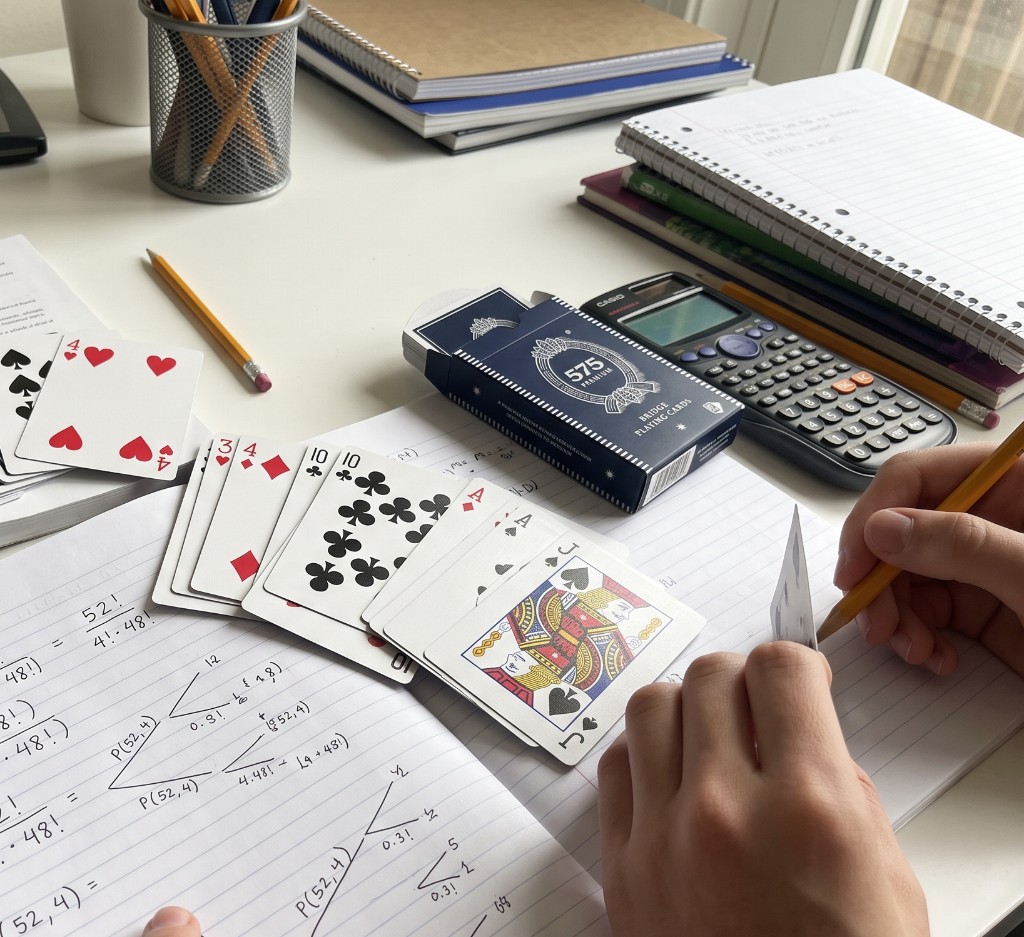
A standard deck is a pocket probability kit: 52 cards, 4 suits, 13 ranks, and no batteries. These five problems sit at high-school level—combinations, expectation, and the pigeonhole principle—and each one uses an ordinary poker deck. Work them before you read the answers. A poker deck on the desk makes the counting easier to see.
1. How many 5-card hands are there?
Order does not matter in a dealt hand. The count is the combination
C(52, 5) = (52 × 51 × 50 × 49 × 48) / (5 × 4 × 3 × 2 × 1) = 2,598,960.
That number is the denominator for almost every poker probability. Two hands that contain the same five cards are the same hand, which is why we divide by 5! instead of using permutations.
2. Chance that five cards all have different ranks
Choose 5 ranks out of 13, then one of 4 suits for each rank:
C(13, 5) × 45 = 1,287 × 1,024 = 1,317,888.
Divide by the result from problem 1:
1,317,888 / 2,598,960 ≈ 0.507.
About half of all 5-card hands have five different ranks (high card, straight, flush, or straight flush). The other half contain at least one repeated rank: a pair, two pair, three of a kind, a full house, or four of a kind. The same count falls out one card at a time. The first card can be anything. The later cards must avoid the ranks already dealt: 48/51, then 44/50, then 40/49, then 36/48. Multiply those four fractions and you get the same 50.7%.
3. Expected number of hearts in a bridge hand
A bridge deal gives each player 13 cards. Let X be the number of hearts you hold. Writing X as a sum of 13 indicators—“is this card a heart?”—and using linearity of expectation:
E[X] = 13 × (13/52) = 3.25.
You do not need the full hypergeometric distribution to get the average. Linearity holds even though the cards are dealt without replacement. Across many deals, hearts per hand cluster around 3 or 4, and 3.25 is the long-run mean. The same idea gives 10.5 expected clubs-or-spades in a 21-card rummy hand, or one expected ace in a 13-card hand (13 × 4/52 = 1).
4. Two pigeonhole facts you can prove in a minute
- Five cards force a shared suit. There are only 4 suits. If each of 5 cards had a different suit, you would need 5 suits. So at least two cards share a suit. Four cards are not enough: one of each suit is possible.
- Fourteen cards force a shared rank. There are 13 ranks. A fourteenth card must repeat one of them. Thirteen cards can still be one of each rank.
These are existence proofs, not probabilities. They are the right tool when a textbook asks “must there be…” rather than “how often…”.
5. How deep is the first ace?
Shuffle fairly and turn cards until the first ace appears. Where do you expect that ace to sit?
The 4 aces cut the deck into 5 gaps: before the first ace, between aces, and after the last ace. The 48 non-aces are spread symmetrically across those gaps, so each gap holds 48/5 = 9.6 non-aces on average. The first ace therefore sits just after the opening gap:
E[position] = 9.6 + 1 = 10.6.
The general pattern for k special cards in a deck of n is (n + 1) / (k + 1). Here n = 52 and k = 4, so (52 + 1) / (4 + 1) = 53/5 = 10.6. The same formula says the first heart (k = 13) is expected at position 53/14 ≈ 3.8.
A short homework set
- Show that the number of 13-card bridge hands is C(52, 13), and compute its order of magnitude (it is about 6.35 × 10¹¹).
- Explain why the expected number of aces in a 5-card hand is 5 × 4/52 ≈ 0.385, using indicators rather than listing poker categories.
- What is the smallest number of cards that guarantees three of one suit? (Nine: two in each suit is still possible with eight cards.)
- After you see the first card, why is the chance the second card matches its colour 25/51 rather than 1/2?
Keep a complete 52-card deck, jokers set aside, so the counts stay honest. If the pack is missing a card, every denominator above is wrong. For classroom sets that get shuffled hard, a nylon plastic deck survives the term better than paper; the maths does not change with the material. When you want the games these counts come from, start with 13-card and 21-card rummy or bridge, where the 13-card hand is the whole point.