
Rummy Variations Around the Globe: From Indian 13-Card to Gin and Canasta
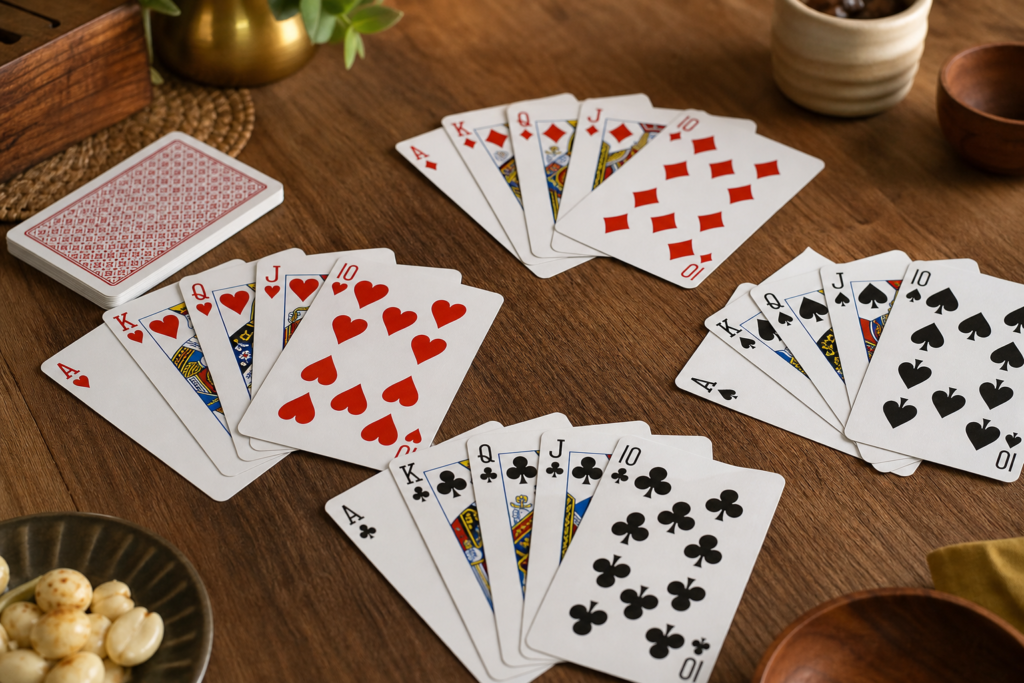
Rummy is less one game than a family of games that share a heartbeat: draw, discard, and build melds—sets of equal rank or runs in one suit. From Mumbai living rooms to Caribbean clubs and American kitchen tables, the same French-suited pack bends into dozens of local favourites. Here is a practical tour of the major variants, what makes each distinct, and who tends to love them.
What every rummy game shares
Almost all versions use one or more standard 52-card decks (often with jokers). Players take turns drawing from the stock or discard pile, then discard one card. The goal is to arrange your hand into valid melds and go out—or score fewer penalty points than everyone else. House rules matter: agree on wild cards, initial meld minimums, and scoring before the first deal.
Indian 13-card rummy (Points, Pool, Deals)
Across India, 13-card rummy is the default. Two decks plus printed jokers are common for three or more players; a turned card sets the wild rank. A legal declare needs at least one pure sequence (no joker). The card rules stay the same across formats—only the metagame changes:
- Points rummy: each deal stands alone; deadwood converts to points (or chips)
- Deals rummy: a fixed number of deals (often two or three); lowest total wins
- Pool rummy: players drop out when they cross a ceiling (101 or 201)
Best for: competitive family tables and anyone who likes a sharp, decisive finish. Full rules: Indian 13-card rummy.
Gin Rummy and Oklahoma Gin
Gin Rummy grew in early-1900s America as a tight two-player duel: ten cards each, melds stay hidden, and you knock when your unmelded deadwood is low—or go gin with none left. Rounds are short; memory and discard reading matter more than table talk.
Oklahoma Gin adds a twist: the first upcard sets the knock threshold (face cards often mean you must go gin). Same deck and hand size, higher tension. Best for: pairs who want a serious but quick game. See Gin Rummy for two.
Canasta
Born in Uruguay in the 1940s and later a North American craze, Canasta is partnership rummy at scale: two decks, large hands, melds on the table, and the signature seven-card canasta. The discard pile can freeze; going out has strict conditions. Best for: four players who enjoy teamwork and long evening scores. Basics: Canasta.
Kalooki (Kaluki)
From Jamaica through British clubs, Kalooki (also Kaluki) weaponises the discard pile: players may buy a needed card—and usually take a penalty card from stock. Opening often requires a minimum point meld. Two decks and jokers; hand sizes vary by house (often 9 or 13). Best for: lively groups who like fighting over every discard. Guide: Kalooki.
Contract Rummy (and Shanghai)
Contract Rummy (sometimes Progressive or Shanghai Rummy in shorter forms) runs a fixed ladder of deals—two sets, a set and a run, three runs, and so on. You cannot coast on one lucky hand; each round demands a different shape. Best for: marathon game nights and players who like variety without learning a new game each week. See Contract Rummy.
Lebanese and Levantine table rummy
Family tables across Lebanon and the wider Levant often play an open-meld style: two decks, generous jokers, early lays, and laying off on anyone’s melds. Rules vary by household more than by rulebook. Best for: big gatherings where conversation matters as much as scoring. Overview: Lebanese Rummy.
Rummikub and tile cousins
Rummikub is not a card game—it uses numbered tiles in four colours—but the DNA is pure rummy: sets, runs, and rearranging the table. If your family already owns the tile set, the skills transfer cleanly to card rummy (and vice versa). Keep it in mind as a travel-friendly cousin when cards are impractical, not as a replacement for a good twin pack at home.
Which variant should you deal tonight?
- Two players, short rounds: Gin or Oklahoma Gin
- Indian family or club night: 13-card Points, Pool, or Deals
- Four players, partnerships: Canasta
- Competitive discard fights: Kalooki
- Long evening, changing goals: Contract Rummy
- Open table, lots of guests: Lebanese-style rummy
Most of these games reward matching twin packs and clear indices—especially multi-deck sessions. Browse rummy decks in the 575 / Nylon shop, or dig deeper into deck choice in best playing cards for rummy. Made in India decks built for repeated shuffles keep the focus on melds, not warped corners.
Wherever you learned the game—points rummy after dinner, gin on a rainy afternoon, or canasta with cousins—the pack in your hand is the same portable idea, remixed by region. Pick a variant, agree the house rules, and deal.